
Every Vortex Site in Sedona: The Complete List
Sedona has more vortex sites than most visitors realize. Here's every known vortex location — the big four, the secondary sites, and a few spots that don't make the tourist maps.
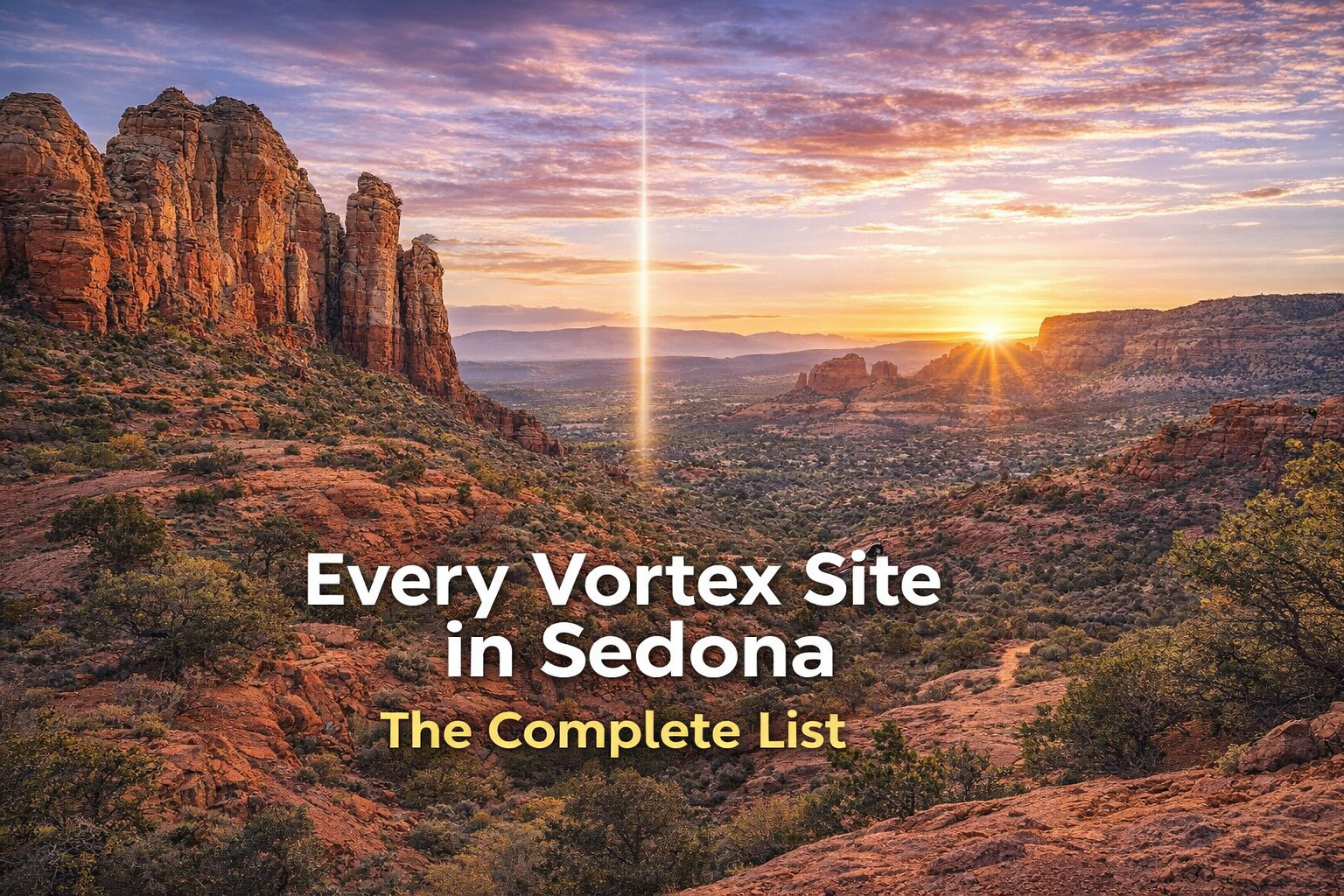
Most Sedona guides mention four vortexes. That's not wrong — Cathedral Rock, Bell Rock, Airport Mesa, and Boynton Canyon are the main sites identified in 1980 and they're still the ones that draw the biggest crowds.
But Sedona has more than four. Depending on who you ask and how you define "vortex site," there are anywhere from 10 to 20 locations where visitors and practitioners report distinct energy. Some are well-known. A few rarely make the tourist maps.
This is the complete list. Every recognized vortex site in the Sedona area, organized from the most visited to the least, with what you need to know about each one.
The Big Four
These are the original sites identified by Page Bryant in 1980. They remain the most visited, the most documented, and the most consistently reported vortex locations in Sedona. If you're visiting for the first time, these are where to focus. See the full comparison of all four for a side-by-side breakdown.
1. Cathedral Rock
| Energy Type | Masculine / Electric |
| Trail Distance | 1.2 miles round trip |
| Difficulty | Moderate to hard (steep scramble) |
| Best Time | Sunrise |
| Red Rock Pass | Required |
| GPS | 34.8208, -111.7897 |
Cathedral Rock is the strongest vortex in Sedona. The energy is raw, activating, and intensely emotional. The trail ends at a saddle between two towering spires where most visitors instinctively sit down and go quiet. This is where skeptics become believers.
The last section is a steep rock scramble requiring hands and feet. It's not dangerous but it's not casual. Wear proper shoes and bring water. The parking lot is the smallest and most competitive of any vortex site — arrive before sunrise on weekends.
This is the site where I experienced the water element transmission. The night before, I received a strong intuition about water energy. The next day at Cathedral Rock, it rained with zero rain in the forecast.
2. Bell Rock
| Energy Type | Balanced / Electromagnetic |
| Trail Distance | 3.6 miles (full pathway loop) |
| Difficulty | Easy (pathway) to moderate (scramble) |
| Best Time | Any / Morning for fewer crowds |
| Red Rock Pass | Required |
| GPS | 34.8057, -111.7632 |
Bell Rock is where I tell everyone to start. The balanced energy grounds without overwhelming. The pathway is flat and accessible. You can see the formation from the parking lot. It sits on what's believed to be a significant quartz crystal deposit, and the vibration here is subtle but consistent — a steady hum I felt through my feet during Qi Gong practice.
Look for the twisted juniper trees near the base. They're the most visible physical evidence of vortex energy in Sedona and they're concentrated around this site.
3. Airport Mesa
| Energy Type | Masculine / Electric |
| Trail Distance | 0.5 miles (overlook) / 4.3 miles (full loop) |
| Difficulty | Easy (overlook) to moderate (loop) |
| Best Time | Sunset |
| Red Rock Pass | Not required (overlook pullout) |
| GPS | 34.8585, -111.7827 |
Airport Mesa is the most accessible vortex and the best sunset in Sedona. The overlook is a quarter mile from the road with 360-degree views of every major red rock formation. The energy is masculine and electric — clarifying, energizing, upward-flowing. If you only have time for one vortex, this is the pragmatic choice.
No Red Rock Pass needed at the overlook pullout. Arrive 30 to 45 minutes before sunset to secure a spot.
4. Boynton Canyon
| Energy Type | Feminine / Receptive |
| Trail Distance | 5 to 6.5 miles round trip |
| Difficulty | Moderate |
| Best Time | Early morning |
| Red Rock Pass | Required |
| GPS | 34.9053, -111.8510 |
Boynton Canyon is the most sacred vortex site in Sedona. The Yavapai-Apache people have regarded it as holy ground for centuries — they know it as Che Ah Chi. Ancient cliff dwellings and petroglyphs confirm generations of ceremonial use.
The energy is feminine and receptive — inward-drawing, calming, integrating. The hike through the box canyon is the most beautiful trail in the area. Don't skip the Kachina Woman formation on a spur trail near the trailhead — many visitors feel the strongest energy there.
Arrive before 8 AM. The Enchantment Resort at the canyon mouth adds foot traffic. Bring food and water for the longer trail.
The Secondary Vortex Sites
These sites don't appear on every tourist map but are recognized by experienced practitioners and locals. Several of them offer more solitude and, in some cases, energy that's just as distinct as the big four.
5. Devil's Bridge
| Energy Type | Electric |
| Trail Distance | 4.2 miles round trip (from Mescal trailhead) |
| Difficulty | Moderate |
| Best Time | Early morning |
| Red Rock Pass | Required |
| GPS | 34.8996, -111.8136 |
Devil's Bridge is Sedona's largest natural sandstone arch and one of the most photographed spots in Arizona. The arch itself is 54 feet high and you can walk across the top of it. The energy here is electric — a buzzing, activating quality that feels different from the more focused energy at the big four sites.
The hike is popular and the arch gets crowded by mid-morning. The Dry Creek Road trailhead requires a high-clearance vehicle on the dirt road. The Mescal trailhead adds about 2 miles but is accessible by any vehicle. Get there early for both the parking and the experience.
6. Schnebly Hill
| Energy Type | Balanced |
| Access | High-clearance or 4WD vehicle required |
| Difficulty | Easy once you arrive (the drive is the hard part) |
| Best Time | Morning or sunset |
| Red Rock Pass | Required |
| GPS | 34.8769, -111.7277 |
Schnebly Hill is the vortex most visitors miss — and the one locals love for exactly that reason. The drive up the unpaved Schnebly Hill Road is rough and requires a capable vehicle, but the reward is a panoramic red rock plateau with 360-degree vortex exposure and almost no one else there.
The energy is balanced and cleansing. Practitioners describe it as a reset — like the slate gets wiped clean. If you've been to the big four and want something deeper and more private, this is where to go.
7. Soldier Pass
| Energy Type | Grounding |
| Trail Distance | 4.4 miles round trip |
| Difficulty | Moderate |
| Best Time | Morning |
| Red Rock Pass | Required (limited parking permits) |
| GPS | 34.8812, -111.7758 |
Soldier Pass is home to the Seven Sacred Pools — natural tinajas carved into the rock that hold water after rain. The energy here is deeply grounding, earthy, and quiet. It's a different quality from the more intense or activating energy at the big four sites.
Parking is extremely limited and sometimes requires advance permits. That restriction is actually a gift — it keeps crowds thin and preserves the solitude that makes this site special.
8. Chapel of the Holy Cross
| Energy Type | Subtle / Spiritual |
| Trail Distance | No hiking required |
| Difficulty | Easy (short walk from parking) |
| Best Time | Morning for light, any time for the chapel |
| Red Rock Pass | Not required |
| GPS | 34.8286, -111.7628 |
The Chapel of the Holy Cross is a Catholic chapel built directly into the red rock in 1956. It sits on what many consider a minor vortex site — the energy is subtle compared to the big four, but the combination of architecture, spirituality, and landscape creates something unique.
No hiking required. The chapel is a short walk from a small free parking lot. The views from the base alone are worth the stop. This pairs well with a Bell Rock visit — it's 10 minutes north on Highway 179.
9. Red Rock Crossing
| Energy Type | Feminine / Gentle |
| Trail Distance | 1 mile round trip (to the creek viewpoint) |
| Difficulty | Easy |
| Best Time | Late afternoon for light on Cathedral Rock |
| Red Rock Pass | Required (Crescent Moon Ranch area) |
| GPS | 34.8283, -111.8017 |
Red Rock Crossing gives you the iconic postcard view of Cathedral Rock reflected in Oak Creek. The energy here is the gentlest of any vortex site — soft, feminine, and calming. It's a completely different experience from climbing Cathedral Rock itself.
This is the best site for families, people with mobility limitations, or anyone who wants the Cathedral Rock energy without the steep scramble. It's also the ideal spot to decompress after an intense morning at the main Cathedral Rock trail. Sit by the creek, eat lunch, let the gentler energy settle what the stronger site stirred up.
10. Courthouse Butte
| Energy Type | Electric / Upflow |
| Trail Distance | 4 miles (loop around both formations) |
| Difficulty | Easy to moderate |
| Best Time | Morning |
| Red Rock Pass | Required (same lots as Bell Rock) |
| GPS | 34.7997, -111.7530 |
Courthouse Butte stands directly adjacent to Bell Rock and shares the same trailhead parking. Most visitors walk right past it on their way to Bell Rock and never realize there's a separate vortex site here. The 4-mile loop trail circles both formations and is one of the more scenic and uncrowded hikes in the area.
The energy is electric with a strong upflow quality — activating but less intense than Cathedral Rock. It pairs naturally with a Bell Rock visit since you're already at the same trailhead.
See All Sites on the Map
Every vortex site listed above is pinned with GPS coordinates on the interactive Sedona vortex map. You can filter by energy type, trail difficulty, and distance from town to plan your route.
Plan Your Visit
- 3-day Sedona vortex itinerary — sequences the big four sites over three days
- Best time to visit Sedona vortexes — seasons, time of day, and crowd patterns
- Parking guide and Red Rock Pass — where to park at every trailhead listed above
- Where to stay in Sedona — area comparison with price ranges
- Things to do in Sedona — beyond the vortexes
- First-timer's guide to vortex energy — what to expect before your first visit
- Meditation techniques for vortex sites — how to work with the energy at each site
For the complete guide with trail details and documentation, visit Sedona Energy Vortexes.
Frequently Asked Questions
How many vortex sites are in Sedona?
There are four main vortex sites: Cathedral Rock, Bell Rock, Airport Mesa, and Boynton Canyon. Including secondary sites like Devil's Bridge, Schnebly Hill, Soldier Pass, Chapel of the Holy Cross, Red Rock Crossing, and Courthouse Butte, the total is around 10 recognized locations.
Which Sedona vortex is the strongest?
Cathedral Rock is widely considered the strongest vortex in Sedona. It has the most intense feminine magnetic energy and produces the most powerful reported experiences among visitors.
Which Sedona vortex is easiest to visit?
Airport Mesa is the easiest to reach — a quarter mile walk from the road with no Red Rock Pass needed at the overlook pullout. Bell Rock has the easiest full trail with a flat pathway loop. Chapel of the Holy Cross requires no hiking at all.
Are there secret vortexes in Sedona?
There are no truly secret vortexes, but several sites receive far less attention than the big four. Soldier Pass, Courthouse Butte, and Schnebly Hill see a fraction of the visitors and offer powerful experiences with significantly more solitude.
Can you visit all Sedona vortexes?
Yes. All recognized vortex sites are accessible to the public. The four main sites can be visited in two to three days. Including secondary sites, plan four to five days to experience them all without rushing.