
Sedona's 4 Main Vortex Sites: A Quick Comparison
Sedona has four main vortex sites and each one delivers a completely different experience. Here's a straightforward comparison so you can decide which to visit first — or plan a route that hits all four.
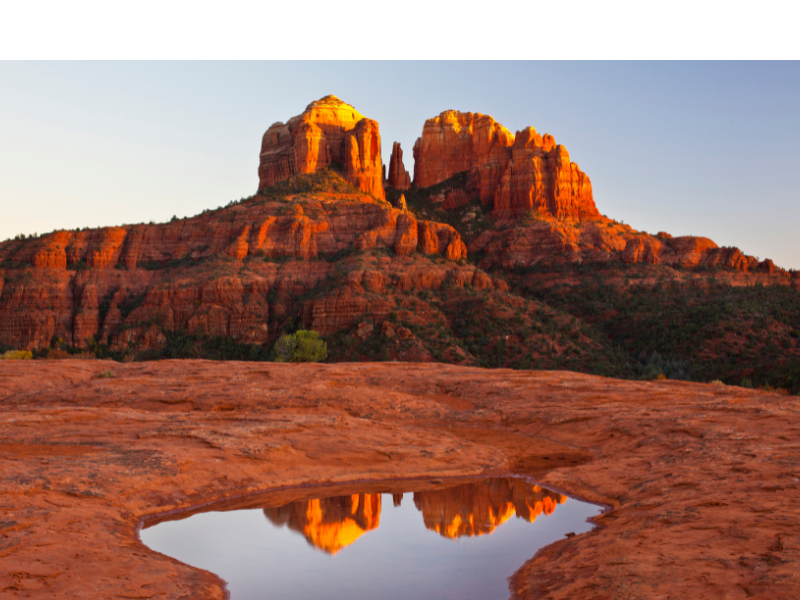
Sedona has four major vortex sites that most visitors focus on: Cathedral Rock, Bell Rock, Airport Mesa, and Boynton Canyon. There are additional sites — Chapel of the Holy Cross, Schnebly Hill, Red Rock Crossing, and others — but these four are the main events.
Each one has a different energy type, a different trail experience, and a different effect on the people who visit. They're not interchangeable. Visiting all four in a few days is manageable and worth doing, because the contrast between them is where the real understanding happens.
Here's how they compare.
The Quick Comparison
| Cathedral Rock | Bell Rock | Airport Mesa | Boynton Canyon | |
|---|---|---|---|---|
| Energy | Feminine / Magnetic | Balanced | Masculine / Electric | Balanced |
| Difficulty | Moderate-Hard | Easy-Moderate | Easy-Moderate | Moderate |
| Distance | 1.2 mi | 3.6 mi loop | 0.5 mi overlook | 5-6.5 mi |
| Time | 1-2 hours | 1-2 hours | 30 min-2.5 hrs | 2.5-4 hours |
| Best Time | Sunrise | Any / Morning | Sunset | Early Morning |
| Red Rock Pass | Required | Required | Not required* | Required |
| Best For | Deep introspection | First-timers | Sunset & clarity | Sacred connection |
*Airport Mesa overlook pullout does not require a Red Rock Pass. The loop trail parking areas do.
Cathedral Rock — The Strongest Vortex
Cathedral Rock is where people who came to Sedona as skeptics leave as believers. It's the strongest magnetic vortex in the area, classified as feminine energy — meaning it draws inward and downward. Visitors describe it as calming, deeply emotional, and introspective.
The trail is only 1.2 miles round trip but the last section is a steep rock scramble that requires hands and feet. The vortex energy is strongest at the saddle between the two main spires. This is not a casual hike. But it's the single most powerful experience I had in Sedona.
Go at sunrise. Go alone if you can. Give yourself at least twenty minutes sitting at the saddle.
Bell Rock — The Best Starting Point
Bell Rock is where I tell every first-time visitor to start. The pathway is flat and easy. The energy is balanced — a combination of masculine and feminine that grounds rather than overwhelms. You don't need to scramble or suffer to feel something here.
Bell Rock sits on what's believed to be a massive quartz crystal deposit. The vibration is subtle but consistent. Visitors leave feeling stable and centered rather than buzzing or emotional. It's the vortex equivalent of a deep breath.
Look for the twisted juniper trees near the base. They're one of the most visible pieces of physical evidence for vortex energy in Sedona.
Airport Mesa — The Best Views and Sunset
Airport Mesa is the most accessible vortex and the most pragmatic choice if you only have time for one. The overlook is a quarter mile from the road, gives you 360-degree views of the entire Sedona landscape, and at sunset it's the single best visual experience in the area.
The energy here is masculine and electric — upward-flowing, activating, and clarifying. People describe feeling lighter, more awake, and more mentally clear. It's the opposite of Cathedral Rock's deep inward pull.
No Red Rock Pass needed at the overlook pullout. Fifteen minutes from most hotels. Bring a jacket for sunset.
Boynton Canyon — The Most Sacred Site
Boynton Canyon is the vortex that locals consider the most sacred. The Yavapai-Apache people have regarded it as holy ground for centuries, and ancient cliff dwellings throughout the canyon confirm its significance.
The energy is balanced like Bell Rock, but deeper and quieter. The hike is the longest of the four main sites at 5 to 6.5 miles round trip through a beautiful box canyon. Don't miss the Kachina Woman formation on a spur trail near the trailhead — many visitors feel the strongest energy there.
Arrive before 8 AM. Bring food and water. Respect the land.
Which Vortex Should You Visit First?
If you've never been to a vortex site: Start at Bell Rock. The easy trail and balanced energy give you the best introduction without overwhelming you. If you feel something there, you'll feel something everywhere else in Sedona.
If you only have time for one: Airport Mesa at sunset. Close to town, short hike, stunning views, and the masculine energy is distinct enough to give you a clear sense of what vortex sites are about.
If you want the most powerful experience: Cathedral Rock at sunrise. This is the deep end. Go alone, go early, and give yourself time at the saddle.
All Four in Two Days
If you want to experience all four main vortexes, here's the sequence I'd recommend:
Day 1 morning: Bell Rock — grounding start, easy trail, sets the baseline
Day 1 afternoon: Cathedral Rock — deeper experience, steep but short, emotional depth
Day 2 morning: Boynton Canyon — sacred, longer hike, arrive early for quiet
Day 2 sunset: Airport Mesa — close it out with the best view in Arizona
This sequence builds intentionally. You start with the most accessible and grounding energy, move into the most intense and introspective, spend a morning in the most sacred and historically significant, and finish with the most expansive and clarifying. By the end of day two, you'll have experienced all four energy types and you'll have a very clear sense of whether Sedona's vortexes are real for you.
Beyond the Big Four
These are the main sites, but they're not the only ones. Sedona has additional vortex locations that are less visited and, in some cases, more interesting because of it:
- Chapel of the Holy Cross — Spiritual architecture built into the red rock. Short visit, unique energy.
- Schnebly Hill — Remote, requires 4WD access. Cleansing energy. Almost no crowds.
- Red Rock Crossing — Cathedral Rock from the creek side. Gentle, feminine, family-friendly.
- Courthouse Butte — Right next to Bell Rock but overlooked by most visitors. Strong upflow energy.
- West Fork — The only forest vortex. Completely different landscape and energy from the red rock sites.
For the complete guide to every vortex in Sedona with interactive maps and GPS coordinates, visit Sedona Energy Vortexes.
Practical Notes for All Four Sites
Red Rock Pass: Required at Cathedral Rock, Bell Rock, and Boynton Canyon. $5 per day, $15 per week. Buy at the Coconino National Forest South Gateway Visitor Center on Highway 179 or at self-service kiosks. Not required at the Airport Mesa overlook pullout.
Water: Bring at least one liter per person per hike. Sedona's elevation and dry air dehydrate you faster than you expect. Bring more for Boynton Canyon.
Footwear: Real hiking shoes for Cathedral Rock and Boynton Canyon. Decent sneakers are fine for Bell Rock pathway and the Airport Mesa overlook.
Time: Don't rush. The biggest mistake visitors make is treating vortex sites like a checklist. Drive to the trailhead, hike up, take a photo, leave. That's tourism, not experience. Budget at least 20 minutes of sitting quietly at each site. That's when the real experience happens.
Go early: Every single vortex site in Sedona is better before 9 AM. Fewer people, cooler temperatures, better light, and a measurably different quality of silence.
Frequently Asked Questions
What are the four main vortexes in Sedona?
The four main vortex sites in Sedona are Cathedral Rock (feminine energy), Bell Rock (balanced energy), Airport Mesa (masculine energy), and Boynton Canyon (balanced energy). Each delivers a distinct experience.
Which Sedona vortex should I visit first?
Bell Rock is the best starting point for first-time visitors. The trail is easy, the energy is balanced and approachable, and it gives you a clear introduction to what vortex sites feel like without overwhelming you.
Can you visit all four Sedona vortexes in one day?
It is physically possible but not recommended. Two per day over two days gives you enough time to actually sit at each site and have a genuine experience. A good split is Bell Rock and Cathedral Rock on day one, Boynton Canyon morning and Airport Mesa sunset on day two.
Which Sedona vortex is the strongest?
Cathedral Rock is widely considered the strongest vortex in Sedona. It produces the most intense reported experiences among visitors, particularly emotional depth and a strong inward-pulling sensation.
Do you need a Red Rock Pass for Sedona vortexes?
A Red Rock Pass is required at Cathedral Rock, Bell Rock, and Boynton Canyon trailheads. It is not required at the Airport Mesa overlook pullout. Daily passes cost $5 and weekly passes cost $15.